Usage of PrDOS
Prediction Submission
Enter one or more protein sequences into the form, in plain text or FASTA format.
Several sequences can be submitted at once in multi-FASTA format, up to 50 sequences
per submission, which is limited by the available computational resources.
The server accepts the 20 single letter codes for the standard amino acids and
the code 'X' generally used for non-standard amino acids.
Other codes, for ambiguous amino acids and for particular non-standard amino acids,
are replaced by 'X' automatically, and whitespace in the query sequence is removed.
Sequences longer than 2048 residues are not accepted, because of the calculation cost.
| Amino acid | Single letter code |
|---|
| Alanine | A |
| Cysteine | C |
| Aspartic Acid | D |
| Glutamic Acid | E |
| Phenylalanine | F |
| Glycine | G |
| Histidine | H |
| Isoleucine | I |
| Lysine | K |
| Leucine | L |
| Methionine | M |
| Asparagine | N |
| Proline | P |
| Glutamine | Q |
| Arginine | R |
| Serine | S |
| Threonine | T |
| Valine | V |
| Tryptophan | W |
| Tyrosine | Y |
| Amino acid | Single letter code |
|---|
| Asparagine or aspartic acid | B |
| Glutamine or glutamic acid | Z |
| Leucine or Isoleucine | J |
| Amino acid | Single letter code |
|---|
| Selenocystein | U |
| Pyrrolysine | O |
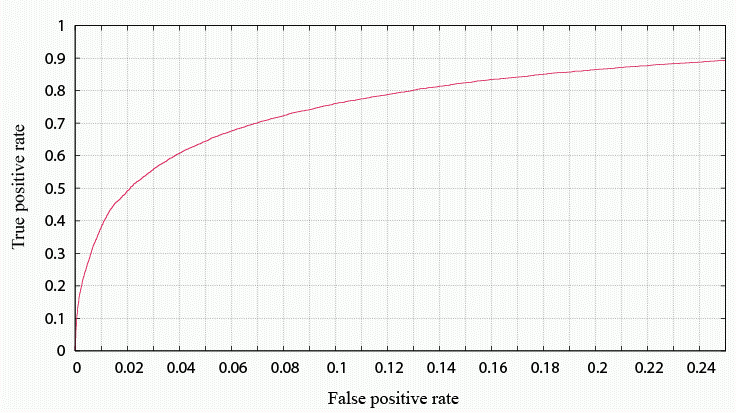
There is a trade-off between prediction sensitivity (true positive rate) and false
positive rate: allowing a higher false positive rate gives a more sensitive prediction.
Which false positive rate is acceptable, and what sensitivity to expect, depends on the
aim of the prediction.
The receiver-operating characteristic (ROC) curve below shows the sensitivity
(true positive rate) obtained at a given false positive rate.
To recover at least 60% of the disordered regions, set the false positive rate to 4%.
The default is 5%.
ROC curves of PrDOS
If the "Receive prediction results by e-mail" checkbox is not ticked,
this page shows a progress report until the prediction has finished,
and then returns the results in HTML.
A sequence of 500 residues or fewer usually completes in under a minute,
though this depends on the length of the query protein and on how busy the server is.
For longer sequences, or for submissions of many sequences at once,
using the "Receive prediction results by e-mail" option is recommended.
The e-mail includes a link to the same HTML formatted results.
Output format of prediction results
E-mail outputs
Results returned by e-mail include a link to the HTML formatted results, and the predicted
disorder probability of each residue in plain text.
The table has four columns.
The first is the residue number and the second the amino acid type.
A '*' in the third column means the residue is predicted to be disordered.
The fourth column gives the disorder probability of the residue.
Example of e-mail outputs
 No  AA Pred Probability
--------------------------
   1  A  *   0.85
   2  W  *   0.76
   3  L  *   0.82
   4  E  *   0.84
   5  A  *   0.82
   6  Q  *   0.79
   7  E  *   0.80
   8  E  *   0.79
   9  E  *   0.75
  10  E      0.68
  11  V      0.61
  12  G      0.53
HTML formatted outputs
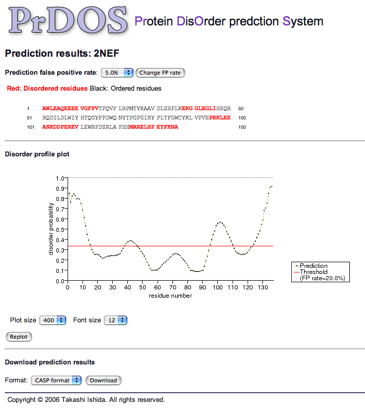
The prediction result page consists of three parts. The top part shows the two-state prediction (disorder/order); residues in red are predicted to be disordered at the given false positive rate. The middle part plots the disorder probability of each residue along the sequence, where residues above the red threshold line are predicted to be disordered; the size of the plot can be changed on the page. At the bottom, the raw prediction results can be downloaded in CSV or CASP format.
Example of HTML formatted outputs